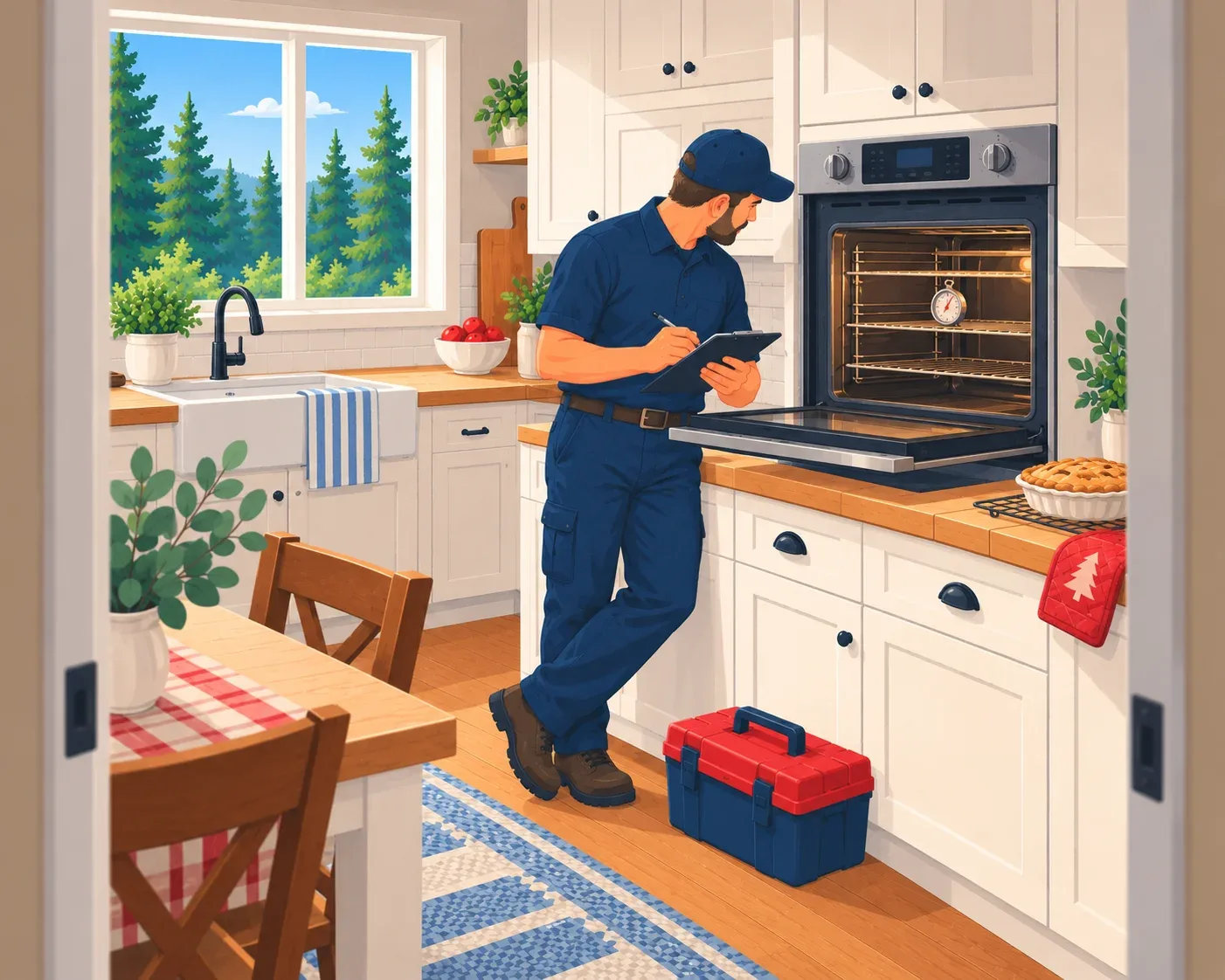
Pies blackened on the bottom while the crust stays blond, thirty minutes just to reach temperature, a door still latched long after self-clean? Our technician measures what the cavity actually reaches, tracks the trouble to one part and replaces it right there in your kitchen.
Wall units, ranges and double ovens across the township run into the same six faults. Each tag shows what gets tested first.
A burnt-through spot on the lower coil, a gas igniter drawing too little current for its valve, or the temperature probe giving out.
A probe that has wandered from calibration, a loose plug on its harness, or a board relay stuck closed.
A lower element fading out, an upper element that never glows, or a rear fan that stopped spinning.
The lock motor stalled halfway, or its switch never reports that the latch opened.
Moisture behind the keypad, a broken sensor wire, or an oven control that has failed outright.
An old igniter with a faint glow, or burner ports crusted shut by years of spills.
Oven styles we fix
Whether it came with the house or arrived on a delivery truck last month, chances are our technicians have already had one just like it apart on the workbench.
On digital ovens, almost every fault shows up as an F and a number. GE and LG versions are listed side by side.
Key reads as stuck
A keypad button is registering as pressed, usually because damp got in under the overlay.
Call a technicianSensor shorted
The oven sensor reads as a short, so heating becomes erratic or stops.
Call a technicianControl self-check failed
The electronic control has detected a fault in its own board.
Call a technicianControl board failure
The main oven control has failed and needs replacing.
Call a technicianTouch pad key error
Kill power at the breaker briefly, restore it and press a key to see if the code returns.
Try this firstMeat probe error
Press Clear/Off, remove the probe and try the cooking mode again.
Try this firstConvection fan error
The upper convection fan is not running as the control expects.
Call a technicianLower door lock failure
The locking system on the lower oven did not finish its cycle.
Call a technicianCodes that survive a power reset almost always mean a failed part, so phone us to have it tested.
(249) 502-9402Home cooks around the township, baking evenly again.
Self-clean finished and the door simply would not open, with family arriving for dinner. He freed it, put a fresh motor in the latch, and the roast still went in on time.
Every loaf had a charred base. The convection fan had died. After swapping it, he verified the temperature using a probe from his bag.
The gas side took ages to catch and gave off a strange smell. New igniter, cleaned burner, and now it catches almost instantly.
Before assuming the worst, rule out a forgotten setting. Check these first.
Clock set after an outage
On a few models, the oven stays cold until someone enters the time.
Control lock off
If keys are ignored, hold the lock pad until the padlock symbol clears.
Element looks intact
With the oven cold, no blisters or splits on the lower element.
Thermometer agrees
Run it at 350°F (175°C) for twenty minutes, then compare the dial with the thermometer.
Leave these to us
Cakes still lopsided or raw inside?
Certified and insured oven specialists measure it and finish the job.
Let us know what is acting up and the best number for you. The rest is on us.
Prefer the phone?
(249) 502-9402Request a Visit
Thank You!
Your message has been sent successfully. We'll get back to you shortly.
Thank You!
Your message has been sent successfully. We'll get back to you shortly.